Why choose a radiant heater?
- Provides instant, focused warmth with no warm-up time
- Great for outdoor or uninsulated spaces
- Silent or near-silent operation, no fan required
- Efficient in breezy or open areas where convection heaters fall short


Shop all the latest deals in one place

15% low price guarantee*

Keep your information safe

Wooden Hanging Parasol Umbrella
Product Recall - Wooden Hanging Parasol Umbrella - find out more
Radiant heaters provide instant warmth by emitting infrared heat that directly warms people and objects in its path. Rather than heating the air in the room, radiant heaters focus on targeted areas, making them ideal for spot heating in cooler, draughty spaces.
They are often used in garages, workshops, bathrooms or anywhere fast, directional heat is needed. Because they produce warmth you can feel right away, they are a great solution for short bursts of comfort.
Radiant heaters are best suited to:
They are also popular in outdoor or semi-outdoor areas, provided the heater is designed and rated for that type of use.
Radiant heaters use a visible element, such as a glowing quartz or halogen bulb, to produce infrared heat. This heat travels in straight lines and warms the surfaces it touches, including people, furniture and objects, rather than circulating through the air.
Because of this direct heating method, warmth can be felt almost immediately after switching the heater on. Most radiant heaters are freestanding or wall-mounted and some include adjustable tilt or multi-bar controls for focused heat delivery.
Radiant heaters are ideal when you need warmth you can feel right away, especially in areas that are difficult to heat using traditional convection methods. However, because they do not heat the air, the warmth disappears quickly once the heater is turned off.
These heaters often emit visible light and may get hot to the touch, so they are not always suitable for households with children or pets. Radiant heaters are best used in shorter sessions or in specific zones rather than as a full-room solution.
If you need long-lasting, low-noise heat in an enclosed space, consider a column, panel or micathermic heater instead.
To choose the right heater size for your space:
This helps ensure efficient heating without overloading your power usage. You can also look for room guides on packaging or product listings to match wattage with room type.
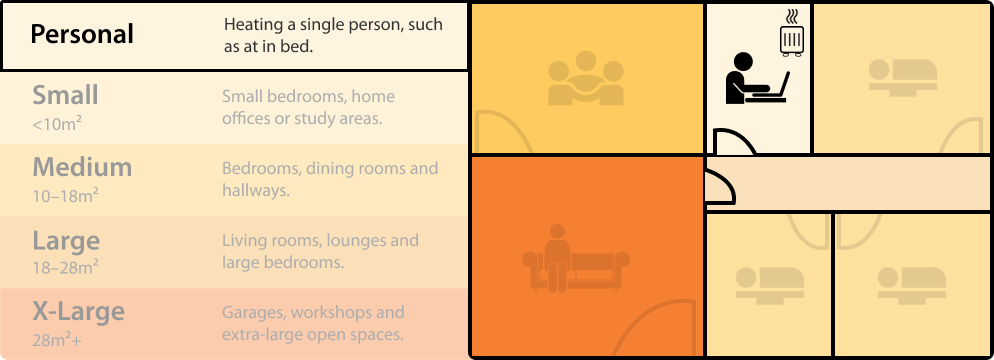
Radiant heaters typically use between 1 and 2.4 kilowatts, depending on the model and number of elements. They are powerful for short bursts but are not the most efficient option for continuous or whole-room heating.
Heater running costs depend on wattage, electricity rates in your area and how long the heater runs each day. As energy prices can fluctuate across New Zealand, use cost calculators or your electricity provider’s tools to estimate usage. For the most accurate info, base estimates on your local kWh rate and usage patterns.
To pick the best model for your space:
For instant, direct warmth in outdoor or open spaces, radiant heaters are a smart solution. Discover high-performance options from Goldair built for patios, workshops and garages.
Compare electric heater types below or jump straight to the one that suits you:

Medium - Large (10–28 m²)
Quiet and efficient warmth for personal spaces like bedrooms.
Learn more about micathermic heaters
Small - Large (10–28 m²)
Great for maintaining steady warmth in living rooms or lounges.
Learn more about column heaters
Small - Medium (10–18 m²)
Ideal for warming up small rooms like home offices or bedrooms.
Learn more about ceramic heaters
Small - Large (10–28 m²)
Quiet, whole-room warmth for medium-sized bedrooms or lounges.
Learn more about convector heaters
Small (<10 m²)
Best for quick bursts of heat in small spaces like bathrooms.
Learn more about fan heaters
Small - Medium (10–18 m²)
Adds cosy visual ambience while gently heating a room.
Learn more about flame effect heaters
Small - Large (10–28 m²)
Slim and discreet, ideal for background heating in bedrooms or hallways.
Learn more about panel heaters
Small (<10 m²)
Delivers direct heat to people or objects, perfect for spot warming.
Learn more about radiant heatersA radiant heater uses infrared technology to emit heat that directly warms people and objects — not the surrounding air. This makes them ideal for outdoor or draughty spaces, where warm air can easily escape.
Radiant heaters provide focused, directional heat. They’re most effective when aimed at people or specific areas rather than heating the entire room.
Most radiant heaters are safe when used properly. Many include tip-over protection, overheat shut-off, and protective grills. However, because the elements can get hot, they should be kept clear of flammable materials and away from children or pets.
Radiant heaters are typically energy-efficient for short bursts or targeted use. They provide immediate heat and don’t waste energy warming unused areas. Most models range from 1200W to 2400W.
Radiant heaters are often used in covered patios, balconies, garages and workshops. Some models are IP-rated for weather resistance, making them suitable for semi-outdoor environments.
Many radiant heaters are wall-mountable or ceiling-mountable, which helps maximise floor space and provides better directional heat. Always follow the installation instructions for safe positioning.
Radiant heaters are usually silent, since they don’t rely on fans or moving parts. This makes them suitable for quiet environments or focused workspaces.
Radiant heaters warm objects directly, while convection heaters warm the air in a room. Radiant is better for outdoor or breezy spaces; convection is better for enclosed rooms needing all-over heat.