Most of the time, when people talk about sustainability, they are talking about environmental sustainability – things like reducing carbon, taking care of our resources, or reducing waste.
The basics
Environmental sustainability in construction and demolition is all about how we can build, demolish, renovate, rebuild, and landscape in a way that preserves our environment in the long-term. This might mean:
- using materials made from sustainable, renewable products or processes, such as harvested timber
- making sure materials are used as efficiently as possible on a building site
- reusing materials again and again and again
- constructing buildings that have a minimal, or even positive, impact on their environment during use
Clearly, that’s all much easier said than done. Even with the best intentions, it’s difficult to know where to start. If you’re feeling that way, you’re not alone.
Changing the ways you work doesn’t have to happen overnight. Just approach it as a journey where every step you take gets you closer to 100 per cent, and even small actions can make a big difference.
Here are some great ways to start reducing your environmental impact on construction jobs:
- Sustainable site planning and design
- Using sustainable building materials
- Waste reduction – use takeback and recycling schemes
Waste hierarchy
There are lots of ways to tackle your waste, but best practise uses the waste hierarchy. It’s an easy to follow framework that helps you decide how to deal with materials, so they maintain the highest value possible throughout their lifetime.

The waste hierarchy shows the preferred order of managing waste. Start at the top of the hierarchy.
- Start by avoiding or preventing waste in the first place
- Next, look for opportunities to reuse or repurpose materials
- Then recycle whatever can’t be reused
- Dispose of whatever is left
To give you an example of how this works in practice, let’s start with soft plastic packaging
- First off, try to eliminate it altogether. You can do this by talking to your suppliers e.g. use M10’s nude packaging options
- Secondly, think about whether it can be reused, e.g. repackaging another product
- Next step, can you repurpose it? This could mean using a plastic sheet for waterproofing, for example.
- Recycling - it’s a long way down the list, but it’s still better than landfill. So, see if you can recycle your plastic packaging, either locally or by sending it to a processor in another city. Your local waste provider may be able to help you figure out your options here.
- Then, finally when all else fails, it heads off to landfill.
The circular economy
At the heart of the waste hierarchy is a thing called the circular economy, which is just a different way of thinking about the way we make, use, and dispose of products.
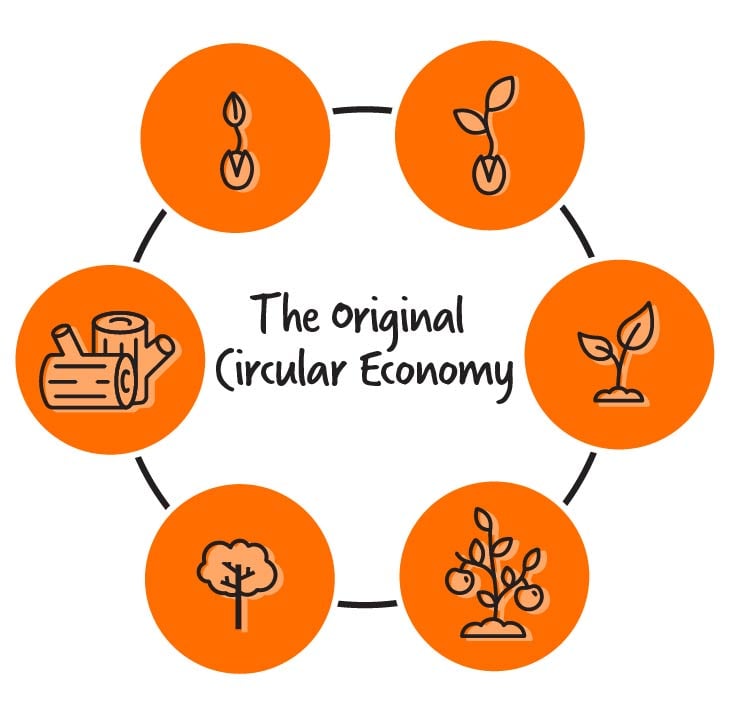
The original circular economy
In the cycles of our natural world, nothing is wasted. The ingredients of all living things are continuously absorbed back into a regenerative, circular system.
The linear economy
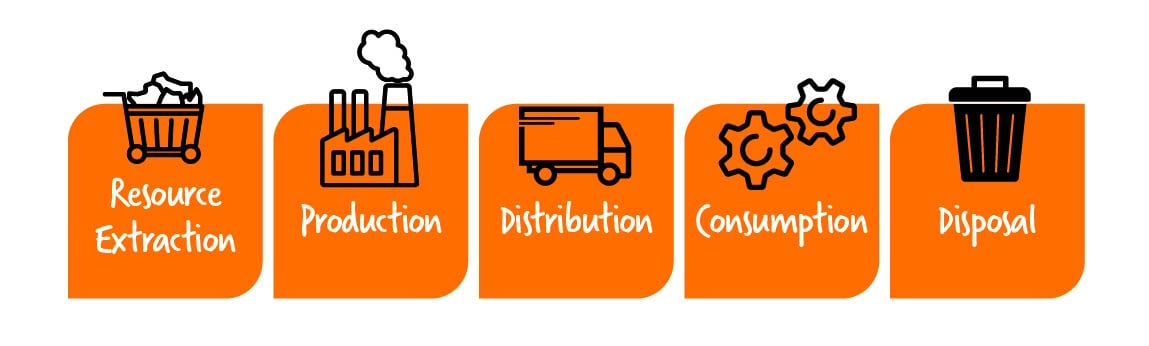
Right now we use a linear economy (with a bit of recycling), which focuses on getting products to the consumer as cheaply as possible.
Where do we need to go from here?
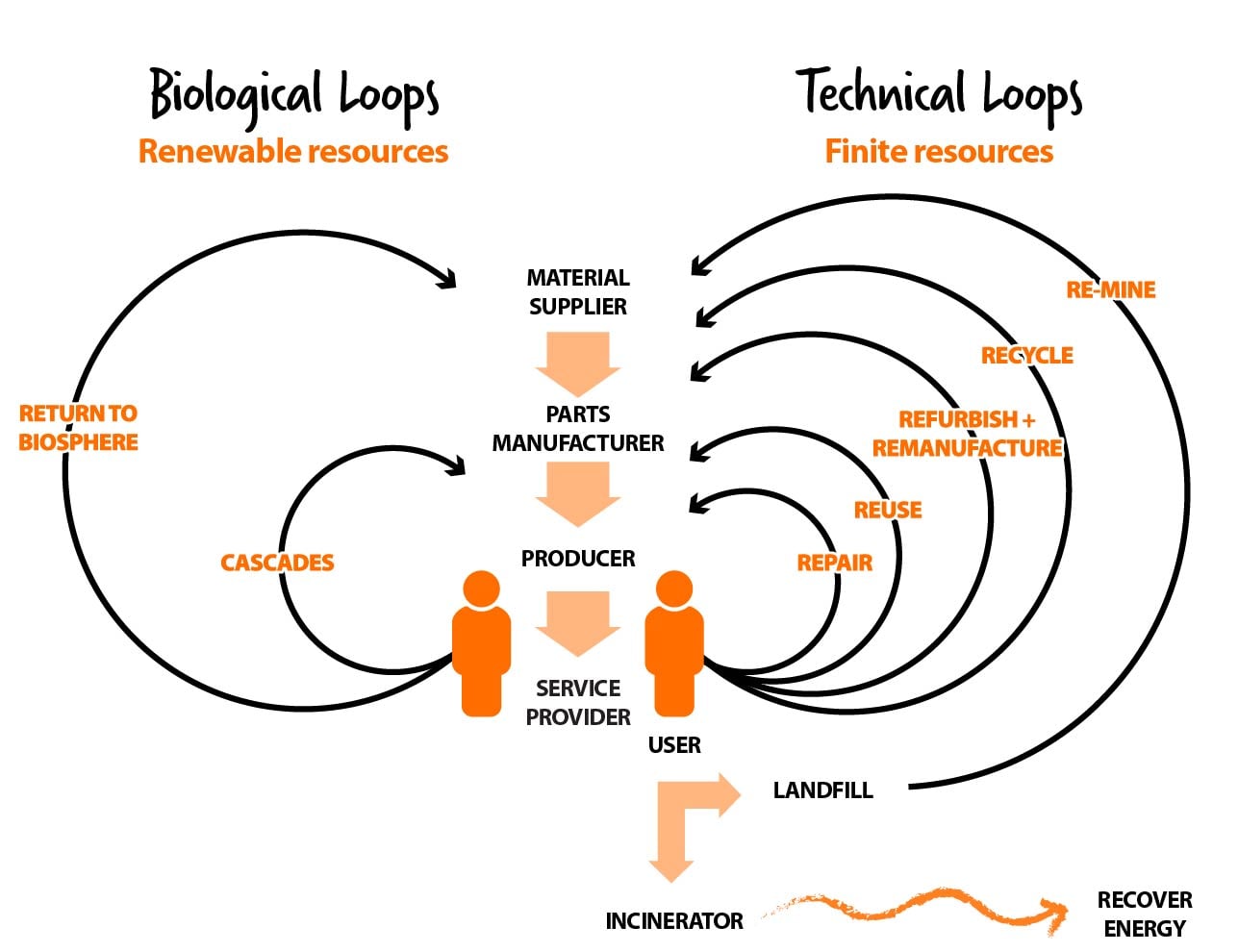
To make the most of the resources available to us, we need to shift to a circular economy, keeping materials in use, at their highest value possible, for as long as possible.
The below diagram shows the butterfly effect of a circular economy. On the left is the circular regenerative processes for natural resources we touched on earlier. On the right is the circular process for man-made products. In a circular economy, we try to keep to the smallest circles possible, for as long as possible.
How does the circular economy work?
The circular economy:
- Focuses on sustainable use of resources.
- Considers the whole life cycle of products, at the start of their life.
- Intentionally designs products for reduced environmental impact, in both their manufacture and lifetime, so they can be repaired and reused for as long as possible.
- Logistics and distribution are important – a circular economy maximises transport. Collaboration is key.
- Are often more easily dismantled and remanufactured, or recycled, when they can no longer be used.
Good sustainable design is the key
Putting it into practice
Transitioning from a linear to a circular economy will require collaboration between governments, industries, and consumers, but as a builder, you can also play an important part.
Construction and demolition waste, which includes materials like concrete, wood, metals, bricks, and plastics, makes up to 50% of waste going to landfill in New Zealand. This can be reduced through good recycling practices, which in turn reduces the demand for raw materials, conserving natural resources and energy.
In our industry, embracing environmental sustainability could mean:
- Working with architects and designers to reduce wastage during the build
- Thinking about your waste streams and how you’re going to minimise them before you start a build
- Sorting your waste on site, so different types of materials can be reused or recycled
- Reducing your use of new resources by reusing, salvaging, or recycling materials wherever possible
- Sending your construction and demolition materials to be recycled and reused in future projects – you could use the Civil Share app to do this
- Working with your suppliers and sub-contractors to maximise the delivery of goods, so they’re timed with your build and minimise transportation
- Using building techniques which are easily accessed for repair, or easily dismantled at the end of their life so the materials can be reused
Appliances, fixtures, hardware, and materials such as brick, wood, metal, plastic, and concrete are all suitable for salvage or recycling.
Metals and wood are highly recyclable, while materials such as bricks and concrete can be repurposed as fill or driveway bedding.
How do I get started?
Reducing your waste on site doesn’t have to be hard. Start simple by separating and recycling as much as possible. This is obviously easiest if you have a plan from the start, and we can help you create a Waste Management and Minimisation Plan.
Case Study
Check out this case study which reduced waste by saving and relocating homes
Extras for experts
Below are some reliable global and local resources and links to help you explore and learn more about the waste hierarchy and the circular economy.
- Ellen MacArthur Foundation - ellenmacarthurfoundation.org/
A leading organisation advocating for the circular economy with a wealth of resources, reports, and case studies.
Key resources: Circular Economy Concept and Circular Design Guide. - United Nations Environment Programme (UNEP) - www.unep.org/
UNEP offers insights into sustainable consumption and production, with a focus on circular economy principles.
Key resources: Reports, including “Single-Use Plastics: A Roadmap for Sustainability.” - OECD (Organisation for Economic Co-operation and Development) - www.oecd.org/
The OECD provides research and policies on transitioning to a circular economy.
Key resources: Circular Economy in Cities and Regions initiative - European Commission – Circular Economy Action Plan - ec.europa.eu/environment/circular-economy/
A comprehensive strategy for circular economy implementation across the European Union.
Key resources: Detailed policy frameworks and progress updates - Circular Economy Toolkit - circulareconomytoolkit.org
A practical guide for businesses to adopt circular practices, with tools and case studies. - The World Economic Forum (WEF) - www.weforum.org/
Publishes thought leadership and insights on global circular economy trends.
Key resources: “The New Plastics Economy” and “Redesigning Global Value Chains” reports - Cradle to Cradle Products Innovation Institute - www.c2ccertified.org/
Promotes product design innovations that align with circular economy principles. - Global Reporting Initiative (GRI) - www.globalreporting.org/
Provides guidelines for integrating circular practices into business reporting. - 3R Group - www.3r.co.nz
Aotearoa New Zealand-based circular economy and product stewardship experts.
Key resources: Guide to the circular economy and Guide to product stewardship