
Unpacking the Ice Box Challenge
25 June 2026
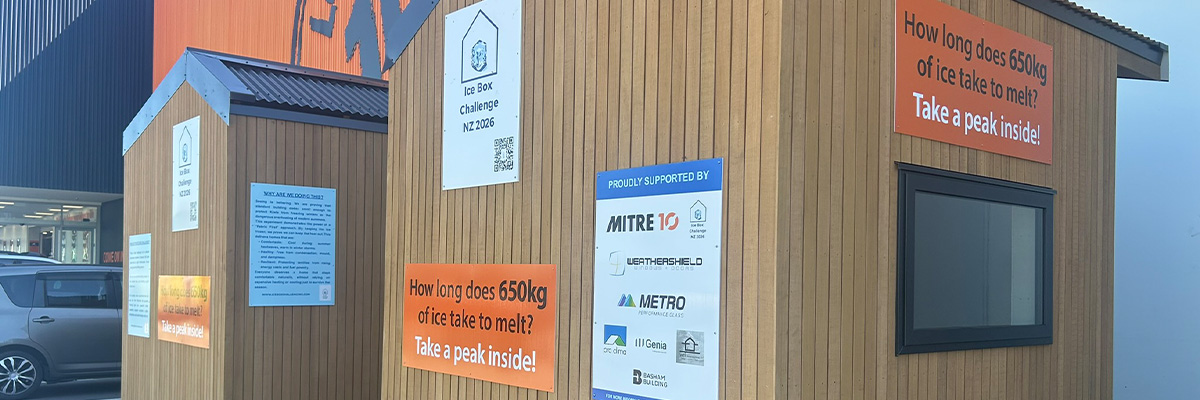
There are two rules of nature everyone knows. One: heat always rises. Two: so do heating costs.
Getting insulation right is a key factor in keeping those costs from going through the roof. BRANZ recently issued the sixth edition of its House Insulation Guide, with guidance on how to calculate R-values to meet the H1 standards.
Of course, it’s worth remembering that these are just the minimum standards. Likewise, if ventilation, shading and windows aren’t placed right, a home can quickly go from an icebox to an oven. If you’re looking to build energy-efficient homes that will get extra attention from buyers looking to save on ongoing running costs, read about the Ice Box Challenge.
What’s the Ice Box Challenge?
The Ice Box Challenge is the ultimate showdown between a standard Building Code build and a high-performance house. It’s the brainchild of builder Lenny Basham, who wanted to test just how much better a home could perform if you went beyond the standard insulation requirements. The project has been supported by Mitre 10, alongside other key sponsors Weathershield Windows and Doors and Metro Performance Glass.
Two identical looking timber-framed "boxes" like sleepouts are put out in the summer heat, each holding a 650kg block of ice. One of the boxes is built to the Building Code minimum, while the other one is designed to be airtight, with high-performance glazing and insulation. You can then see how quickly the ice melts in each box.
The high-performance box has more widely-spaced floor joists than the standard one (450 centres vs 400 centres) and wall framing has reduced studs at 600 centres instead of 400. It also doesn’t use dwangs, to stop heat escaping through thermal bridging.
Upgrades include a vented purlin system, Proclima building wraps and tapes and roofing with a vented ridge. Weathershield thermally broken aluminium joinery is recessed into the wall to line up with the insulation, instead of aluminium joinery installed to the usual standard, which juts out over the exterior cladding. Both boxes are double-glazed, but the high-performance box uses premium Low E glass. An airtight Proclima Intello membrane is installed over the framing, with a 45mm insulated service cavity.
What were the results?
During both Challenges in Nelson and Christchurch, the high-performance “house” still had large chunks of ice left after two weeks. In the standard build, the ice had completely melted.
The key takeaway was that insulation and airtightness create the greatest returns. Positioning windows in line with insulation, with insulation wrapped tightly around openings, significantly improved thermal performance and reduced condensation. Studies have shown this simple design change can improve thermal performance by up to 70 per cent.
Given the tests happened in summer, the fact that the ice didn’t melt as fast in the high-performance house showed how well it maintained even temperatures, compared with a standard build.
The Challenge shows how going beyond minimum build requirements can have a huge impact on how much it costs to keep a home warm and dry. Efficient heating and hot water systems, mechanical ventilation and good extractor fans all play an important part, but it starts with good insulation and installing your windows right.
Visit the Ice Box Challenge website for more.


